Conus austriacus
|
||||
|
|
|
||
|
|
|
||
|
|
|
|
|
|
|
|
|
|
|
|
||||
|
||||
|
|
|||
|
|
|||
|
|
|||
|
|
|||
Conus (Dendroconus) austriacus (Hoernes & Auinger, 1879)
Conus (Dendroconus) reussi (Hoernes & Auinger, 1879)
Descrizione
e caratteristiche:
Questa forma era precedentemente conservata nella collezione dell'Hof-Mineralien-Cabinet come Conus betulinoides, ma, come risulterà chiaro dalla seguente descrizione, è facilmente distinguibile da questa forma.
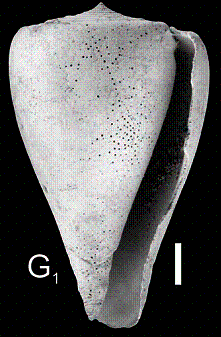
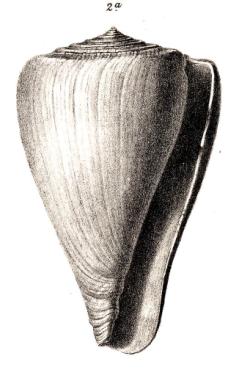
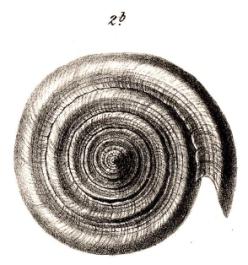
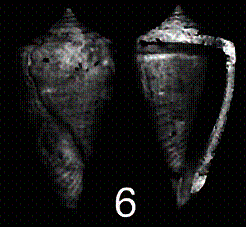
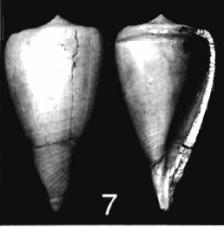
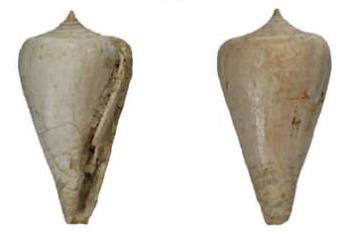
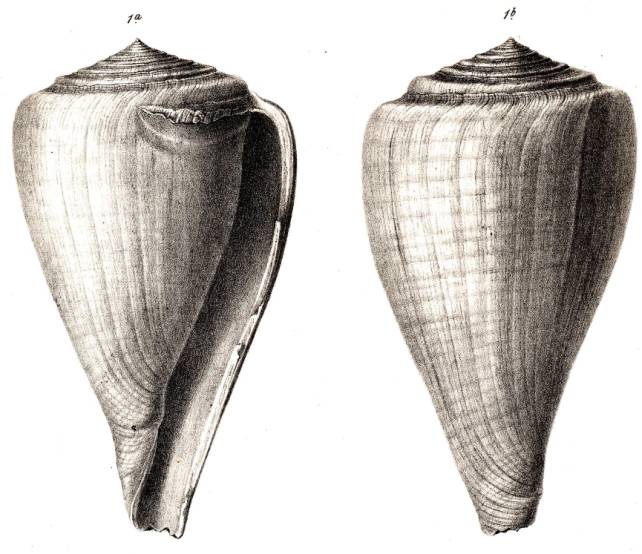
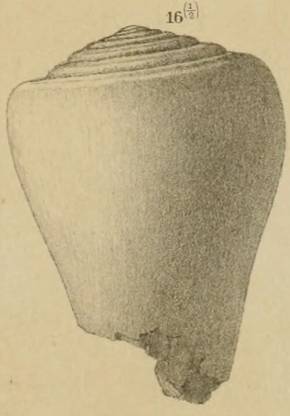
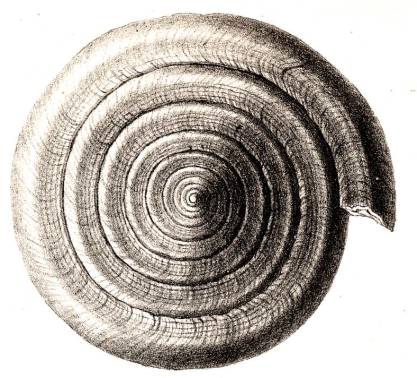
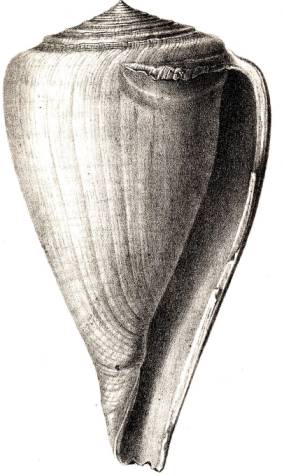
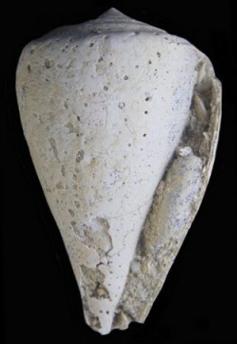
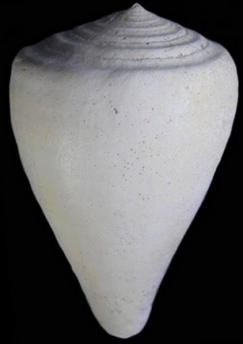
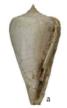
La conchiglia del Dendroconus austriacus è conica, gonfia nella parte superiore e leggermente rientrante nella parte inferiore e quindi a forma di pera, la sua superficie è ricoperta da deboli strisce di crescita a forma di S, oltre a ciò un esemplare molto ben conservato di Lapugy mostra anche una scultura a croce. A questo punto, solchi trasversali distanti e appena percettibili attraversano l'intero guscio. Vicino alla base lamellare compaiono delle strisce trasversali oblique, in rilievo, simili a fili. La spira è moderatamente rialzata, la punta leggermente sporgente, ma ancora un po' prominente. Le singole spire della spira separate da una scanalatura hanno una scanalatura debole, sono dotate di tre o quattro strisce a spirale piuttosto pronunciate, che formano un reticolo obliquo con le strisce di crescita.
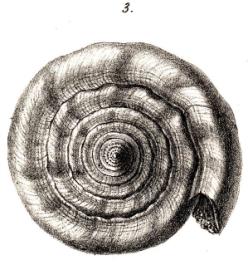
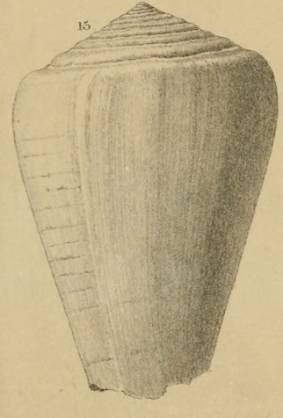
Sui primi giri sono visibili nodi deboli e ravvicinati, ma distinti, che in seguito divergono e sono più deboli in alcune conchiglie e più pronunciati in altre. Il filo mostrato in Fig. 3 da un esemplare di Steinabrunn li mostra meglio; sulle altre conchiglie presenti, questi nodi sono ancora più deboli. L'orifizio è leggermente smarginato nella parte superiore, allargandosi leggermente verso la base. Il bordo esterno dell'orifizio è affilato e sottile.
Abbiamo solo tre conchiglie di questa specie caratteristica: una da Lapugy (Tabella II, Fig. 2), una da Steinabrunn (Fig. 3) e una da Gainfahrn. Delle dimensioni dell'ultimo esemplare, che è gravemente deformato, solo l'altezza può essere determinata con certezza: è di 90 mm. La conchiglia di Lapugy (Fig. 2) è alta 75 mm e larga 47 mm, mentre queste dimensioni per l'esemplare di Steinabrunn (Fig. 3) sono rispettivamente superiori a 75 mm e 48 mm.
Il Conus austriacus, la cui forma appare alquanto strana tra gli altri rappresentanti del sottogenere Dendroconus, sembra essere la più strettamente correlata tra le forme viventi a Dendroconus patricius Hinds, un tipo dell'America occidentale, che Weinkauff considera una varietà di Dendroconus pyriformis Reeve.
Distribuzione:
Miocene: Austria, Ungheria
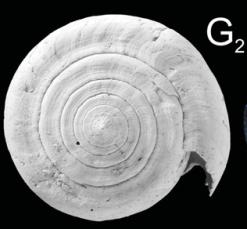
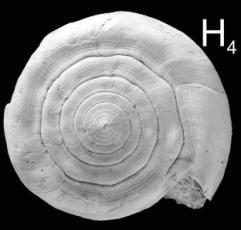
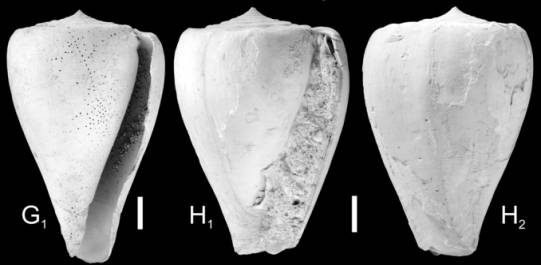
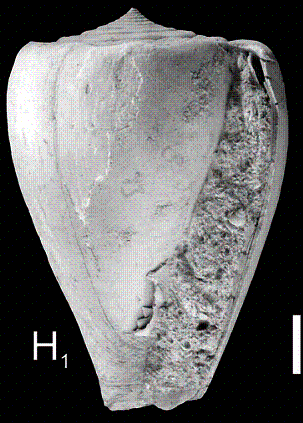
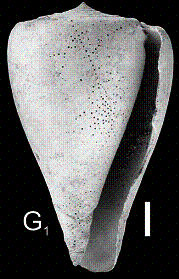
Revised description (6). Moderately large to large pyriform shells of up to 112 mm height. Spire ranging from flat to very low conical; early spire whorls with granulose spiral threads on adapical half; tuberculate along lower suture. Later whorls striate with weak concavity in adapical half and convex abapical part developing large, wide, blurred nodes; suture undulose. Subsutural flexure shallow, moderately curved, strongly asymmetrical. Shoulder angulated; position of maximum diameter distinctly below shoulder passing into relatively elongate last whorl; markedly constricted at base with long, moderately wide, nearly straight siphonal canal. Siphonal fasciole indistinct with prominent growth lines; very weak spiral cords on base; faint spiral cords on last whorl, visible only in tangential light. Colour pattern under UV light only seen on spire whorls, consisting of broad flammulae.
Shell measurements and ratios (6). Only three shells are more or less completely preserved: largest specimen: SL: 112.0 mm, MD: 62.8 mm, mean SL: 92.6 mm (σ = 19.1), mean MD: 54.0 mm (σ = 8.3), spire angle: µ = 142° (σ = 4.4), last whorl angle: µ = 39.3° (σ = 2.1), LW: µ = 1.7 (σ = 0.1), RD: µ = 0.64 (σ = 0.04), PMD: µ = 0.85 (σ = 0.02), RSH: µ = 0.09 (σ = 0.04).
Discussion (6). This rare species is recognized easily by its pyriform shape and the undulose suture around the broad nodes of the spire whorls and the tuberculate early spire whorls. These features separate it well from Monteiroconus . We place this species in Pseudonoduloconus based on the low spire, striate spire whorls, tuberculate early spire whorls and the undulose suture.
Hoernes & Auinger (1879) already discussed if their Conus reussi might simply represent a very large C. austriacus but separated it based on its larger size and because of the less distinct nodes on the spire. Both morphs were collected at the same locality (Steinebrunn); the single specimen of C. reussi has a worn spire and therefore the sculpture is partly abraded. Aside from the size, there is little reason to separate this specimen and we consider C. reussi a subjective junior synonym of Pseudonoduloconus austriacus (as already proposed by Bałuk 1997).
A specimen from the Tortonian of Stazzano in Italy, described by Sacco (1893a) as Conus mercati subaustriacus , might also represent this species, but is too fragmentary for a clear identification.
Paleoenvironment (6). The Austrian localities Gainfarn and Steinebrunn represent shallow water environments with sea grass (e.g. Zuschin et al. 2007).
Distribution in Paratethys (6). Badenian (middle Miocene): Vienna Basin: Gainfarn, Steinebrunn ( Austria) ( Hoernes & Auinger 1879; Sieber 1958b); Carpathian Foredeep: Korytnica ( Poland); Transylvanian Basin: Lăpugiu de Sus ( Romania) (NHMW collection).
Proto-Mediterranean Sea and northeastern Atlantic (6): Langhian (middle Miocene): Loire Basin: Ferrière- Larçon ( Glibert 1952a); Tortonian (late Miocene):? Stazzano (Italy) (as subaustriacus in Sacco 1893a).
Conus austriacus
|
||||
|
|
|
||
|
|
|
||
|
|
|
|
|
|
|
|
|
|
|
|
||||
|
||||
|
|
|||
|
|
|||
|
|
|||
|
|
|||
Conus reussi
|
||
Hoernes & Auinger (1879) already discussed if their Conus reussi might simply represent a very large C. austriacus but separated it based on its larger size and because of the less distinct nodes on the spire. Both morphs were collected at the same locality (Steinebrunn); the single specimen of C. reussi has a worn spire and therefore the sculpture is partly abraded. Aside from the size, there is little reason to separate this specimen and we consider C. reussi a subjective junior synonym of Pseudonoduloconus austriacus (as already proposed by Bałuk 1997) (6). |
||
|
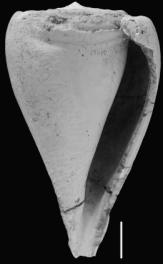
Secondo Sacco, questo esemplare potrebbe avvicinarsi al Conus reussi, ma l’esemplare è troppo incompleto, anche se sembra decisamente più conico. |
Esemplare incompleto e davvero grande |
|
|
|
|
|
|
|
|
|
|
|
|
|
|
|
|
|
|
|
|
|
|
|
|
|
|
|
|
|
|
|
|
|
|
|
||
|
||
|
|
|
|
|
|
|
Bibliografia
Consultata


_a.jpeg)
_b.jpeg)