|
|
|
|
|
|
|
|
|
|
|
|
|
||
|
||
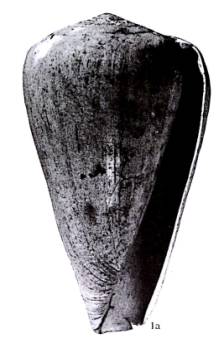
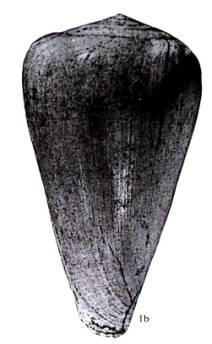
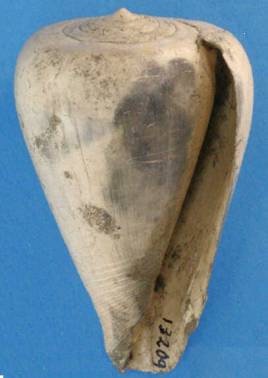
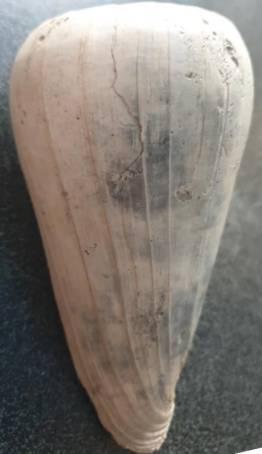
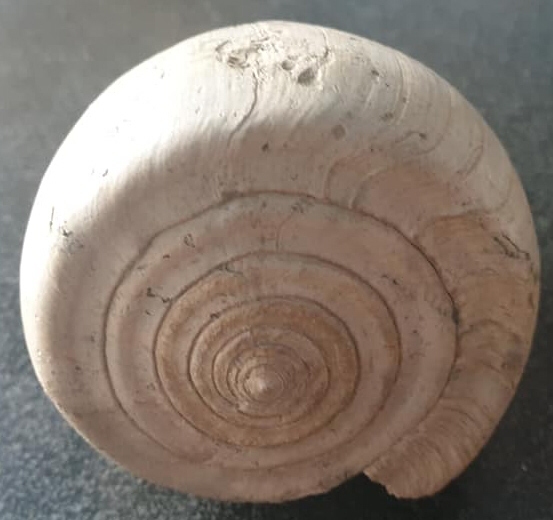
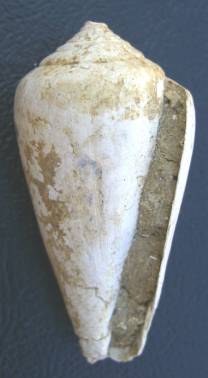
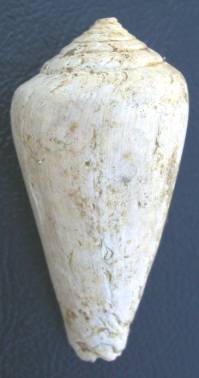
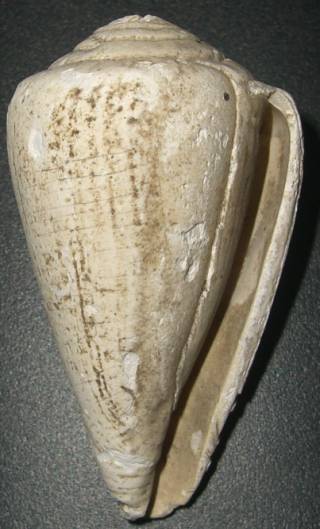
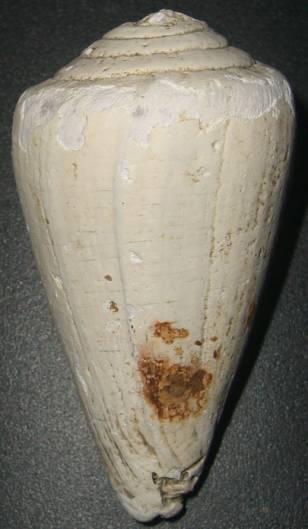
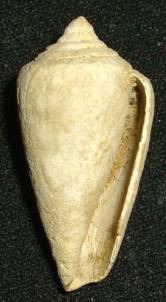
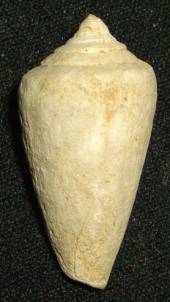
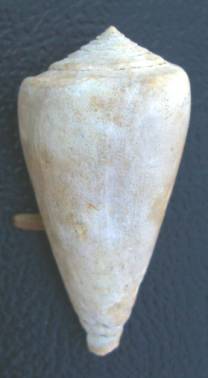
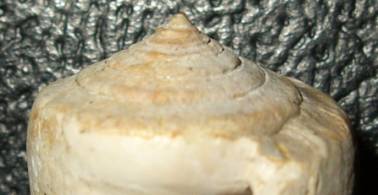
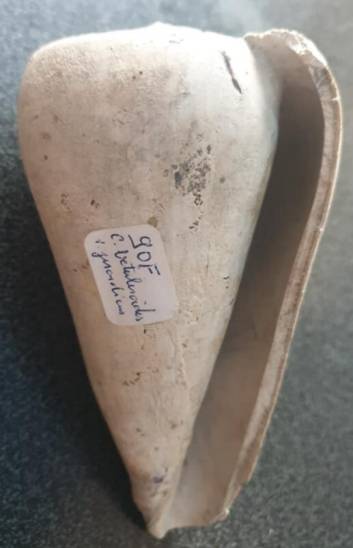
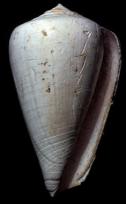
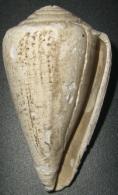
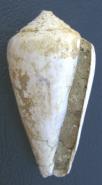
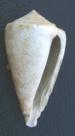
Conus (Lithoconus) betulinoides (Lamarck, 1810)
Descrizione e caratteristiche:
Si
tratta di una conchiglia di dimensioni tra le più elevate, con giri
poco convessi e poco alti e con suture canalicolate. L’apertura è
ampia, il labbro tagliente e la base solcata(2).
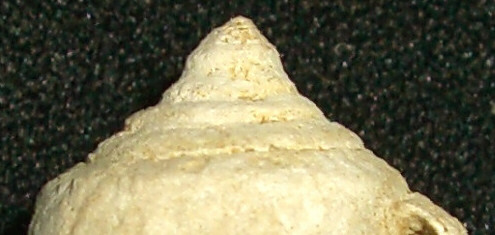
Gli esemplari giovani, che ricordano alquanto il Conus
pyrula ed
il Conus
laeviponderosus,
sono in generale assai mucronati e quindi distinti da quelli adulti,
in cui l’apice è in gran parte eroso(1).
Può presentare una colorazione per lo più giallastra, ma spesso
sono presenti macchie rossigne larghe ed irregolari, o tutta la
conchiglia si presenta roseo-rossastra.
Gli esemplari tortoniani sono generalmente più conici di quelli pliocenici(1).
Secondo hall (1964) tale forma sarebbe sinonimo di Conus gallicus (Mayer-Eymar 1890), caratterizzato dalla spalla più angolosa e dalla forma maggiormente conica(4).
Il Conus cacellensis (Da Costa) nominato dal Cocconi tra i fossili pliocenici del Piacentino è probabilmente una varietà del Conus betulinoides(1).
Conus
(Lithoconus) betulinoides var. exlineata (Sacco, 1893)
Conus lineatus (Borson, 1820)
Conus notatus (Tomlin, 1937)
Descrizione e caratteristiche:
Testa subconica, ornata con solchi lineari distanti; spire piane, apice appuntito; la base è solcata.
La curva delle spire è meno convessa nella parte superiore, leggerissimamente subangulosa(1).
Tomlin propose il nome Conus notatus a causa della preesistenza del nome Hemiconus lineatus.
|
|
|
|
|
|
|
|
|
|
|
|
|
||
|
||
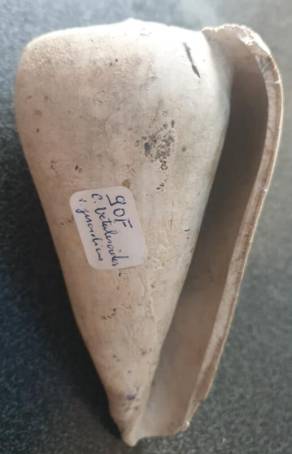
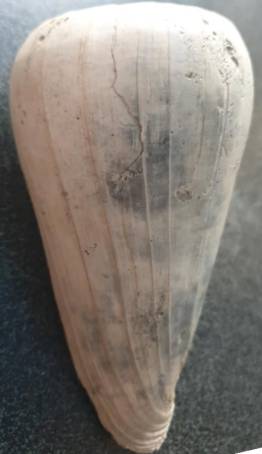
Conus (Lithoconus) betulinoides girondicus (Peyrot, 1930)
Test épais. Taille très grande à l'état gérontique. Formeoblongo-conique ; spire peu élevée, mais aiguë au sommet,àprofil concave, formée d'une dizaine de tours étroits à peuprès plans et conjoints, séparés par d'étroites sutures, ornés,près de la suture postérieure, de deux à trois filets spirauxfort peu saillants et de stries d'accroissement curvilignes irré-gulièrement rapprochées, marquant les arrêts d'accroissementdu sinus labral; dernier tour formant la majeure partie de lacoquille, convexe en arrière, où il est orné comme la spire,régulièrement déclive, assez large en avant, où il présente quelques cordonnets spiraux assez écartés; chez les spécimens plusjeunes, on aperçoit, en outre, sur une portion variable du tour,des sillons assez rapprochés. Ouverture à bords subparallèles, relativement large, surtouten avant, où elle se termine en un canal fort court, tronquésans échancrure; elle est munie, en avant, d'une rainure pariétale fort peu profonde; labre mince, à peu près rectiligne enson miheu, arqué à ses deux extrémités; bord columellairelégèrement convexe, tordu en avant, où il présente un bourrelet surtout développé chez les spécimens gérontiques.
Dim. : Hauteur, 160 mill.; diamètre max., 82 mill.
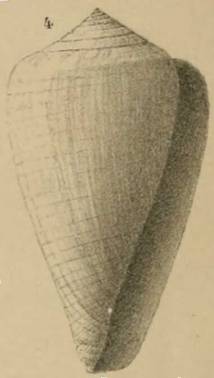
R. et D. — Le spécimen gérontique que je choisis comme typede la mutation helvétienne du Sud-Ouest de la France diffèrede la forme de C. betulinoides — retenue comme typique par — 99 — Brocchi et par M. Sacco (/. c, pl. I, fig. 1) — par son ouverture plus ample en avant, par son bourrelet nuqual plus saillant, ainsi que par l'existence de filets spiraux sur la spire; par ces caractères, il se rapproche davantage de la forme du Tortonien du Portugal figurée par P. da Costa, et que M. Sacco considère comme voisine de sa var. dertomamillata (l. c, pl. I, fig. 7). Celle-ci a toutefois une spire à profil légèrement convexe. Les exemplaires plus jeunes, assez abondants à Salles (Largileyre) ne diffèrent des exemplaires gérontiques que par leurs dimensions plus faibles et leur spire mucronée. Ce sont peut-être de semblables échantillons que Benoist assimilait dubitativement à C. cacellensis Da Costa (p. 13, pl. I, fig. 4-5) ; ils diffèrent toutefois de l'espèce tortonienne du Portugal par leur galbe plus allongé, par leur spire mucronée, par l'ornementation spirale de leurs tours. Il me semble, d'ailleurs, que les spécimens dessinés par Da Costa sous le n° 5 appartiennent à une espèce diffé- rente de ceux représentés fig. 4. Enfin, les spécimens népioniques de C. girondicus se relient à C. maculosus par l'intermédiaire de la var. Salomacensis.
Loc. — Salles (Débat), type (pl. III, fig. 5), coll. Duvergier; Salles Largileyre), spécimen plus jeune (pl. III, fig. 4, 6), coll. Neuville; même loc. et Salles (Minoy), coll. Peyrot. — Helvétien.
Thick shell. Very large size in the mature stage. Oblong-conical shape; spire not very high, but acute at the apex, with a concave profile, formed of about ten narrow, almost flat and conjoined whorls, separated by narrow sutures, ornamented, near the posterior suture, with two to three very slightly projecting spiral filaments and irregularly spaced curvilinear growth lines, marking the growth stops of the labral sinus; last whorl forming the major part of the shell, convex posteriorly, where it is ornamented like the spire, regularly declining, rather wide anteriorly, where it has some fairly spaced spiral cords; in younger specimens, one can also see, on a variable portion of the whorl, rather closely spaced grooves. Aperture with subparallel edges, relatively wide, especially anteriorly, where it terminates in a very short, truncated canal without a notch; It has, anteriorly, a very shallow parietal groove; a thin labrum, almost straight in the middle, arched at both ends; a slightly convex columellar margin, twisted anteriorly, where it presents a ridge, especially developed in gerontic specimens.
Dimensions: Height, 160 mm; maximum diameter, 82 mm.
R. and D. — The gerontic specimen that I choose as the type of the Helvetian mutation from Southwest France differs from the form of C. betulinoides — considered typical by Brocchi and by M. Sacco (I. c, pl. I, fig. 1) — by its wider anterior opening, by its more prominent nuchal ridge, as well as by the presence of spiral filaments on the whorl; By these characteristics, it more closely resembles the Tortonian form from Portugal illustrated by P. da Costa, and which M. Sacco considers to be related to his var. dertomamillata (l. c, pl. I, fig. 7). The latter, however, has a spire with a slightly convex profile. The younger specimens, quite abundant at Salles (Largileyre), differ from the older specimens only in their smaller size and their mucronate spire. It is perhaps similar specimens that Benoist tentatively identified as C. cacellensis Da Costa (p. 13, pl. I, fig. 4-5); however, they differ from the Tortonian species from Portugal in their more elongated shape, their mucronate spire, and the spiral ornamentation of their whorls. It seems to me, moreover, that the specimens drawn by Da Costa under no. 5 belong to a different species from those represented in fig. 4. Finally, the Nepionic specimens of C. girondicus are related to C. maculosus via the var. Salomacensis.
Loc. — Salles (Débat), type (pl. III, fig. 5), coll. Duvergier; Salles Largileyre), younger specimen (pl. III, fig. 4, 6), coll. Neuville; same loc. and Salles (Minoy), coll. Peyrot. — Helvetian.
|
|
|
|
|
|
|
|
Conus (Lithoconus) betulinoides var. sgosus (De Gregorio, 1885)
L’esemplare descritto da De Gregorio conserva in parte una colorazione rosso porpora, più sottilissime linee spirali distanziate, sempre di colore rosso.
Conus (Lithoconus) betulinoides forma sbilmus (De Gregorio, 1885)
Distribuzione:
In Italia è in Piemonte, comunissimo nella località Le Sciolze(3), nel Serravaliano e nel Tortoniano (Miocene). Comune nel Pliocene.
Conus levigatus (Defrance, 1818)
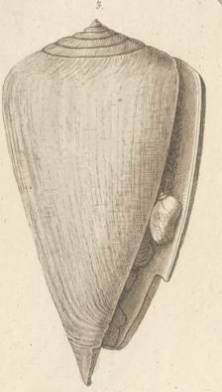
Il Cono liscio Conus levigatus Nob. Conchiglia conica di spira cortissima, composta di dieci a dodici giri depressi e con leggiere strie circolari. Lunghezza 68 millimetri 2 Pollici e mezzo. Questa specie è bianca e liscia; reca alcuni solchi trasversali alla sua base. Se ne vede una figura nell’opera di Knorr vol II TAV C, fig.3. Si trova Piemonte.
E’ un sinonimo del Conus betulinoides (1).
|
|
Conus levigatus Plate CIII fig. 3 (Pag. 286) Knorr und Walch, die Naturgeschichte der Versteinerungen 1768
|
|
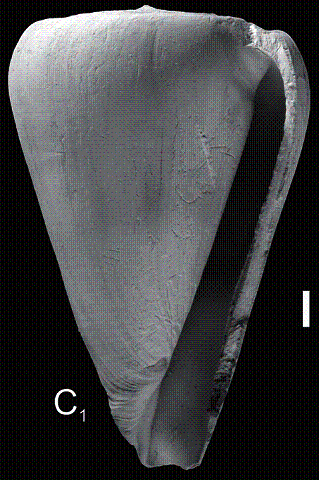
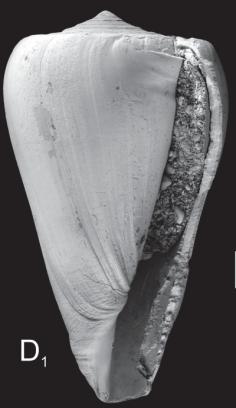
Monteiroconus pervindobonensis (Sacco, 1893)
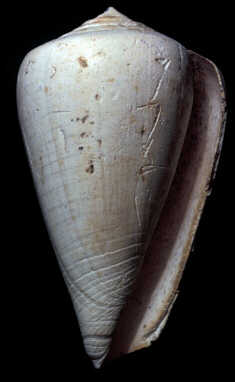
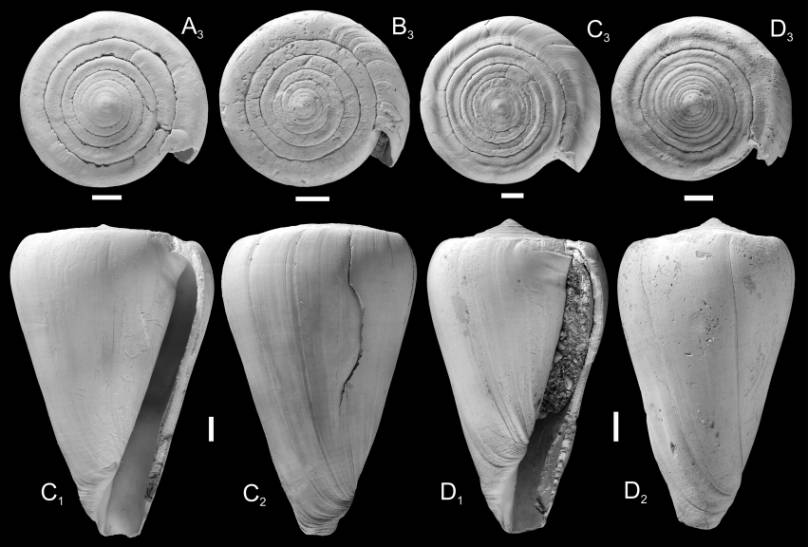
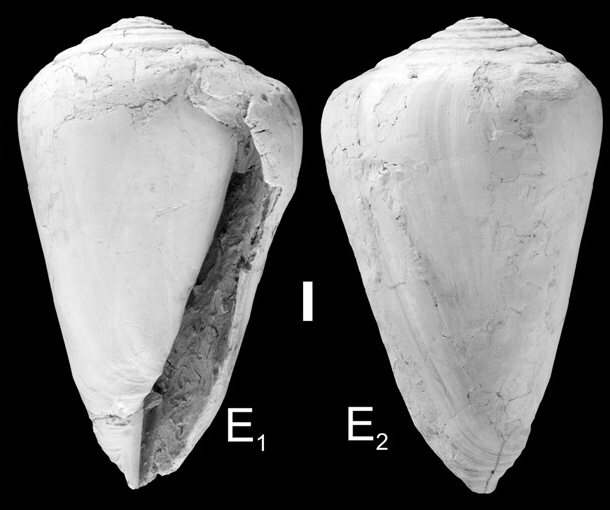
Revised description. Very large shells with low spire; spire whorls striate, weakly convex with shallow central concavity in some specimens. Subsutural flexure shallow and asymmetrically curved. Shoulder rounded or faintly subangulate, position of maximum diameter close below shoulder. Last whorl elongate, regular conical in dorsal view, ventricose in apertural view; not constricted. Aperture wide, slightly excavated at junction from fasciole and inner lip. Fasciole broad, swollen, demarcated from glossy, inner lip by distinct groove. Growth lines on last whorl below shoulder prosocline and straight. Siphonal canal wide, slightly deflected. No colour pattern preserved.
Shell measurements and ratios. n = 5: largest specimen: SL: 124.5 mm, MD: 74.00 mm, mean SL: 101.3 mm (σ = 13.3), mean MD: 62.8 mm (σ = 6.5), spire angle: µ = 135.6° (σ = 7.3°), last whorl angle: µ = 39.2° (σ = 2.6°), LW: µ = 1.61 (σ = 0.08), RD: µ = 0.69 (σ = 0.02), PMD: µ = 0.9 (σ = 0.02), RSH: µ = 0.1 (σ = 0.02), Hörnes (1851, pl. 1, fig. 1) reports a height of 128 mm and a width of 73 mm for the illustrated but lost specimen.
Discussion. The specimen of Hörnes (1851, pl. 1, fig. 1) from Steinebrunn was already lost in 1879 ( Hoernes & Auinger, 1879) and only a few additional specimens in the NHMW collection are available. Unfortunately, Hörnes (1851) presented only the dorsal view of his specimen. Therefore, the conspecificity with the Pliocene Kalloconus betulinoides ( Lamarck, 1810) remained unchallenged. Only Sacco (1893a) proposed the variety name pervindobonensis for this specimen, without discussing specific differences from the type. A re-investigation of the few additional Paratethyan specimens seems to support Sacco’s position. The concave and striate spire whorls, the excavated columella and the deflected siphonal canal of the Vienna Basin specimens differ from the Italian Kalloconus betulinoides as illustrated by Davoli (1972), Pinna & Spezia (1978) and Chirli (1997). The shell is broader and club-shaped, the last whorl less elongate and the last spire whorl is narrower. Therefore, we propose to separate the middle Miocene Paratethyan shells as Monteiroconus pervindobonensis (Sacco, 1893). The generic placement is based on the concave and striate spire whorls.
Paleoenvironment. The specimens from Bad Vöslau, Grund and Immendorf were found in clays indicating an offshore environment but transport from shallow habitats cannot be excluded ( Zuschin et al. 2005, 2006).
Distribution in Paratethys.? Karpatian (early Miocene): Alpine-Carpathian Foredeep: Niederkreuzstetten ( Austria) (Harzhauser 2002). Badenian (middle Miocene): Vienna Basin: Gainfarn, Steinebrunn, Bad Vöslau, ( Austria); Alpine-Carpathian Foredeep: Grund, Immendorf ( Austria) ( Hoernes & Auinger 1879);? Korytnica ( Poland) ( Bałuk 1997);? Pannonian Basin: Letkés, Márkháza, Mátraverebély, Sámsonháza, Budapest: Rákos ( Hungary) ( Kovács & Vicián 2013);? Krka Basin: Gorenje Vrhpolje ( Slovenia) ( Mikuž 2009). (6)
|
|
|
|
|
|
|
|
|
|
|
||
|
||
|
|
|
|
|
|
|
|
|
|
|
|||
|
|
|
|
|||
|
|
|
|
|
|
|
|
|
|
|
|
|
|
|
Bibliografia Consultata
(2) - Carlo Chirli (1997) “Malacofauna pliocenica toscana - vol. I - Superfamiglia Conoidea”, Firenze
(5) - Hoernes (1851 ) “Abhandlungen der Kaiserlich-Koniglichen Geologischen Reichsanstalt, 3 (1 )“
(6) - Harzhauser, Mathias & Landau, Bernard, 2016, A revision of the Neogene Conidae and Conorbidae (Gastropoda) of the Paratethys Sea, Zootaxa 4210 (1), pp. 1-178: 106-108 Monteiroconus daciae