|
|
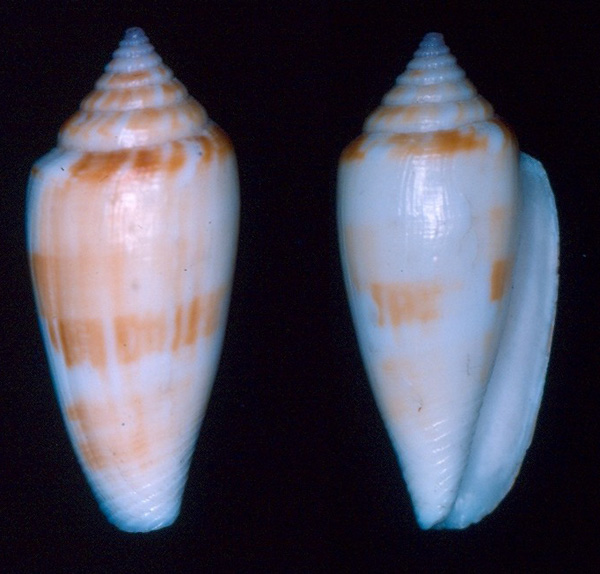
Conus compressus (Sowerby II, 1866)
v
|
|
Type. The holotype is in BMNH (no. 1879.2.26.2), ex coll. T.L. Taylor. The measurements are 24.8 x 10.6 mm (fig. 509) (2).
Type locality. Unknown. Kendrick & Ryland (1981: 4) "nominate"(not designate) the Houtman Abrolhos Archipelago, West Australia (fig. 441), the most likely source area for Sowerby's holotype (2).
Remarks. Sowerby indicated that Conus compressus has "some resemblance to C. anemone Lamarck, but is more solid in texture and the whorls are much more compressed." Generally “C. compressus” is considered to be the high spired forma of C. anemone (vide Basteria 44: 37-38), although some authors recognize these turreted shells as a valid species. However, both interpretations have recently been shown to be wrong (2).
Kendrick & Ryland (1981: 3-4, figs. 3-5) examined an extensive range of specimens of C. anemone. They concluded that the holotype of C. compressus (fig. 509) represents a local forma of C. anemone from the Houtman Abrolhos Archipelago (East Australia), and that it bears little resemblance to the turreted shells from South Australia. This conclusion is accepted by the present authors (Coomans R.G. Moolenbeek& E. Wils) (2).
The first available name for “C. compressus auct." is C. carmeli Tenison-Woods, 1877 (vide Basteria 47: 92-93, fig. 311). The shell can be recognized by the biconic turreted shape, with straight sides, narrow aperture, and angular shoulders on which a carina is present; uncommonly found off the coast of South Australia and Victoria. C. atractus Tomlin, 1937 (vide Basteria 45: 27, fig. 150) is a junior synonym (2).
Material studied. The holotype; we are grateful to Ms. K.M. Way for a photograph of this shell. The collection of R.M. Filmer contains specimens from Wallabi Island, which is just north of Houtman Abrolho (2).
|
|
|
|
|
|
|
|
|
|
|
|
|
|
|
|
|
|
|
|
|
|
|
|
|
|
|
|
|
|
Conus anemone f. carmeli (Lamarck, 1810) |
More biconic than other forms, and with yellowish aperture. Often considered a separate species, and often erroneously referred to as f. compressus. |
Conus anemone f. novaehollandiae (Adams, 1854) |
A low-spired form of C. anemone. A subspecies according to Filmer. |
Conus anemone f. remo (Brazier, 1898) |
A colour variant "splashed with bright orange. |
Conus anemone f. peronianus (Ireale, 1931) |
Growing larger than the nominate, usually with a lower spire and generally brighter in colour than other forms of C. anemone. |
Conus anemone f. saundersi (Cotton, 1945) |
A shape and colour variant. |
Conus anemone f. singletoni (Cotton, 1945) |
Pinkish-white in colour, no or very minimal pattern. A variant with a white shell. |
|
|
Besides variation in shell shape, there is variation in shell structure (5).
Shells from Queensland (Figs. 5-7) and New South Wales (Figs. 8-10) do not have a well developed carina along the shoulder (compare to Figs. 45a, b) (5).
Shells from Victoria have a carina developed but it is not very pronounced (Figs. 11-13) (5).
Tasmanian shells also have the carina present similar to Victorian shells (Figs. 14-16) (5).
Shells from South Australia are most often distinctly carinate (figs. 17-28) (5).
Finally, West Australian shells have little or no development of the carina especially in specimens from central and northern West Australia (Figs. 29-40) (5).
Specimens from southern West Australia (Figs. 37-40) also have little development of the carina (5).
The specimens from Esperance, which is the eastern most West Australian sample available have shells with and without carinae (Figs. 41-44) (5).
Thus, shells at the eastern and western ends of the range are more similar to each other than they are to shells from the central portion of the range in carinal development (5).
Bibliografia
Consultata
(3) - KENDRICK, G. W., & V. A. RYLAND, 1981. Two Australian Conus species re-examined. -Austr.Shell News 34: 3-4.
(5) - Floraconus anemone: An Example of Circular Overlap? John K. Tucker