|
|
|
|
|
|
|
|
|
|
|
Conus fumigatus (Hwass in Bruguière, 1792)
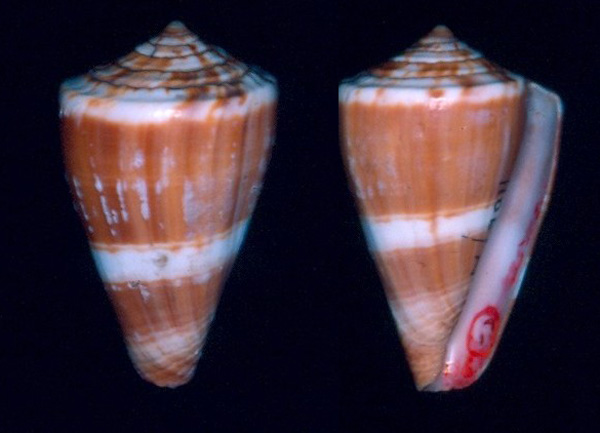
Description: Moderately small to moderately large, moderately solid to solid. Last whorl conical to broadly conical; outline convex at adapical third, straight below. Shoulder angulate. Spire of low to moderate height, outline concave to straight. Maximum diameter of larval shell 0.9 mm. Early postnuclear whorls tuberculate. Teleoconch sutural ramps flat to slightly concave, with 1-2 increasing to 4 spiral grooves, finer and more numerous but weak or even obsolete on later ramps. Last whorl with weak or obsolete spiral ribs at base.
Range: Red Sea; recently reported from the Mediterranean Sea (Libya) (Röckel, 1986) (Pl. 22, Fig. 25).
Reported also in Lybia and Israel.
MNHN-IM-2009-18310 SEC - GOLFE D'ADEN - Djibouti - Monnier E.
MNHN-IM-2012-39359 SEC - (Erroneus) - ILES LOYAUTE - Lifou - Baie du Santal, Baie d'Hunetë - LIFOU 2000 1425 - Determination Moolenbeek R.
|
|
|
|
|
|
|
|
|
|
|
|
|
|
|
|
|
|
|
|
|
|
|
|
|
|
|
|
|
|
|
|
|
|
Remarks. Conus fumigatus was first recorded from the Mediterranean Sea in Libya (Röckel 1986) but not recorded again for three decades until a recent report from Syria (Ammar 2018). This is the first finding in Israel, filling the distributional gap from the Suez Canal northward; only shells of juveniles have been found so far (2).
|
||
|
|
|
|
|
|
|
|
Description (3)
The shell is medium-sized, thick, and conical. The body coil has a shoulder, and the snail is low and conical. Decoration is limited to fine spiral grooves on the end of the body coil towards the tubular canal, and there is a spiral line between the shoulder and the suture. The opening is elongated and narrow with a thin outer lip.
The shell is usually brown or green. There are darker spiral lines on the body coil, a lighter area along the suture, and another in the middle of the body coil, in addition to irregular markings. The opening is grayish on the inside. The common size of this species averages 32.5 mm and is 60 mm in the Red Sea. Its most important distinguishing feature from the local species is its more rigid structure and the presence of nodes on the first coils of the shell.
It lives in the shallow waters of the southern Red Sea. Its presence in the Mediterranean was first recorded on the Libyan coast. It is rare, and its mode of introduction is unknown. It may have been introduced via maritime transport associated with the oil industry. (Rockel, 1986)
Several individuals of this species were found on the Syrian coast, at a depth of -17 / 40m, in the sandy, muddy and detrital seabed (N 35°51'55.21" E 35°49'21.18”) in both the Ras al-Basit and Tartus area (N 34°44'33.10" E 35°55'23.21" ) during the months of March and December of 2007 (Arabia (2011)). It was also found in the Ibn Hani area in March 2010 (Ammar et al., (2013) with a density of 64 individuals/m², and in January 2012 with a density of 32 individuals/m².
La conchiglia è di medie dimensioni, spessa e conica. La spira del corpo presenta una spalla e la spirale è bassa e conica. La decorazione è limitata a sottili solchi a spirale all'estremità della spira del corpo verso il canale tubolare, e vi è una linea a spirale tra la spalla e la sutura. L'apertura è allungata e stretta e presenta un sottile labbro esterno.
La conchiglia è tipicamente marrone o verde, con linee spirali più scure lungo la spirale del corpo, una zona più chiara lungo la sutura e un'altra al centro della spirale. Sono presenti anche segni irregolari e l'apertura è grigiastra all'interno. La dimensione media di questa specie è di 32,5 mm, raggiungendo i 60 mm nel Mar Rosso. La sua caratteristica più distintiva rispetto alle specie locali è la struttura più robusta e la presenza di nodi sulle prime spire della conchiglia.
Vive nelle acque poco profonde del Mar Rosso meridionale. La sua presenza nel Mediterraneo è stata registrata per la prima volta sulla costa libica. È rara; le sue modalità di ingresso sono sconosciute e potrebbe essere arrivata tramite il trasporto marittimo legato all'industria petrolifera. (Rockel, 1986)
Diversi esemplari di questa specie sono stati rinvenuti sulla costa siriana, a una profondità di -17 / 40 m, nel fondale sabbioso, fangoso e detritico (N 35°51'55.21" E 35°49'21.18") sia nell'area di Ras al-Basit che in quella di Tartus (N 34°44'33.10" E 35°55'23.21") durante i mesi di marzo e dicembre del 2007 (Arabia (2011)). È stata rinvenuta anche nell'area di Ibn Hani nel marzo 2010 (Ammar et al., (2013) con una densità di 64 individui/m², e nel gennaio 2012 con una densità di 32 individui/m².
|
|
|
|
|
|
|
|
|
|
|
Bibliografia
Consultata
(9) - Conus fumigatus voucher MNHN:IM-2009-18310 12S ribosomal RNA gene, partial sequence; mitochondrial
(11) - Conus fumigatus voucher MNHN:IM-2009-18310 16S ribosomal RNA gene, partial sequence; mitochondrial