|
|
|
|
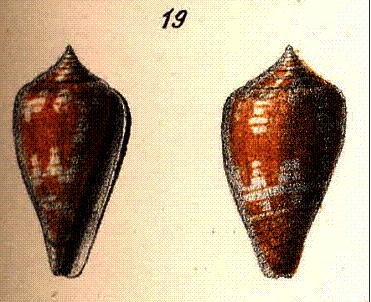
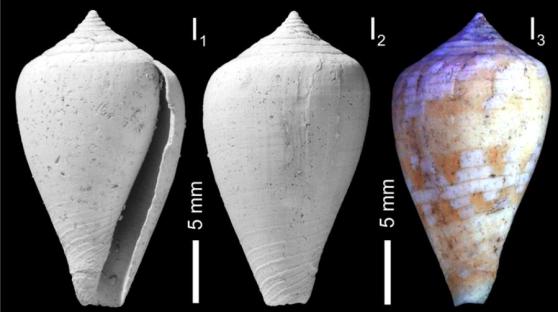
Conus schroeckingeri (Hoernes & Auinger, 1879)
Description:
Small pyriform shell with low conical to coeloconoid spire; early spire whorls angulated, tuberculate; later whorls flat, striate. Subsutural flexure very shallow, weakly curved, moderately asymmetrical. Suture impressed. Last whorl faintly angulated and convex below; constricted. Lower third of last whorl and base covered by wide-spaced, raised spiral cords. Moderately long, weakly reflected siphonal canal. Siphonal fasciole very weak. Aperture narrowing adapically and widening towards siphonal canal. Colour pattern under UV light consisting of regularly spaced, thin spirals on entire last whorl, coinciding with spiral cords on base. Spirals overlain by large, roughly trigonal blotches amalgamating into two irregular bands below shoulder and below midwhorl (2).
Although known by just two specimens, this seems to be a distinct species. None of the other Paratethyan cone species develops such a stout pyriform shape with striate spire whorls and raised spiral cords on the base. This sculpture of wide-spaced, prominent spiral cords on the last whorl is reminiscent of Conus sturi (Hoernes & Auinger, 1879) but the strongly constricted base and the low conical coeloconoid spire exclude that P.schroeckingeri is just a juvenile C. sturi. Further, the colour pattern of delicate spirals overlain by large blotches is unknown from any other Paratethyan species (2).
|
|
|
|
|
|
|
|
|
|
Conus melvilli is a small obtuse cone, with characteristics markings, somewhat resembling those of Conus lucidus (Wood, 1828), Pleistocene of Mexico and Galapagos, on a smaller scale; the transverse brown lines are more numerous, and the short longitudinal ones crossing the interstices less so. The light-brown streaks almost cover the shell, leaving small white patches between the transverse lines. The shell described was picked up by Mr. Melvill at Key West (South of Florida) in 1872, and is at present the only specimen know of the species (4). With reference to the description of Conus boschi, Clover write that the nearly parallel lines crossed with irregular axial lines of the same color form continuous rows of small rectangles (3).
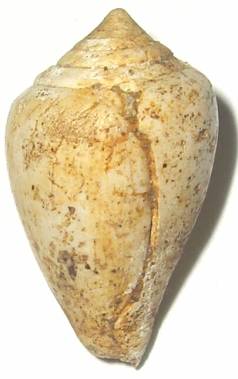
The markings of Conus melvilli are really practically identical to that of Conus schoeckingeri, a rare Miocene species, and some morphological characteristics of Conus melvilli are too similar to those of Conus schroeckingeri to be able to exclude that the two species are closely related to each other: first of all the spire and the apex, really very similar, in addition to a characteristic swelling near the columella.
|
|
|
|
|
|
|
|
|
|
|
|
|
|
|
|
|
|
|
|
|
|
|
|
|
|
|
|
|
|
|
|
|
|
|
|
|
|
|
|
|
Bibliografia consultata