|
|
|
|
|
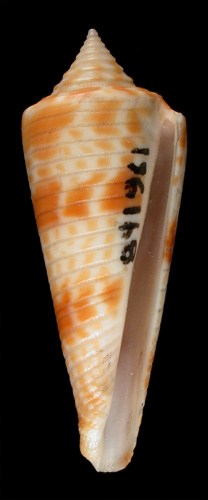
Conus aculeiformis (Reeve, 1844)
Species 240. (Fig. a, Mus. Belcher; Fig. 6, Mus. Stainforth.) (3)
CONUS ACULEIFORMIS. Con. Testa elongato-turbinata, subfusiforms, undique sulcata, sulcis subtilissimè striato, cancellatis, nunc angustis, liris intermediis planis latiusculis, nunc latioribus, liris intermediis rotundatis angustis; albida, fuscescente punctata, maculis fuscescentibus biseriatim cincta; spirá acuminata, apice elato, acuto.
THE PRICKLE-SHAPED CONE. Shell elongately turbinated, somewhat fusiform, grooved throughout, grooves very finely cancellated with striæ, some-times narrow with the intermediate ridges flat and rather broad, sometimes broad with the intermediate ridges rounded and narrow; whitish, dotted with light brown, encircled with two rows of light brown spots; spire acuminated, apex raised, sharp.
REEVE, Pro. Zool. Soc., 1843.
Hab. Cagayan, island of Mindanao, Philippines (dredged from sandy mud at the depth of from twenty-five to thirty fathoms); Cuming.
The specimens collected by Mr. Cuming at the above-mentioned island are mostly smaller than those here figured.
|
|
|
|
|
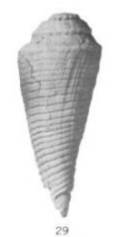
Description (1).
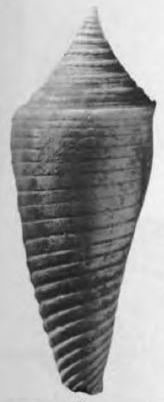
The Hayasaka collection of Byoritzu fossils in the U.S. Geological Survey contains several specimens of this species showing a wide range in the texture, number and spacing of the incised spiral lines. The spirals are always made semipunctate by thin partitions crossing them, the partitions being continuous with the growth lines on the flat bands between the incised grooves. The early whorls have small nodes along the shoulder which remain visible just above the suture.
Conus d'orbignyi ( Andouin ) which occurs in the Byoritzu beds also has semipunctate incised spirals but its shoulder nodes are coarser and persist on the adult whorls.
Nomura regarded three fossils from Java which Martin (1906) identified as living species, C. insculptus Kiener, C. longurionis Kiener, and C. vimineus Reeve as synonyms of C. aculeiformis. They are certainly very closely related if not identical.
One of Martin's species, C. menengtenganus, probably also should be included in this category.
Distribution:
Miocene,? Java, (Yonabaru clay member) Okinawa;
Pliocene,? Java;? Sumatra,? Timor,? Ceram, (Byoritzu beds) Formosa, Japan;
Recent, Indian Ocean, Australia , Philippines.
Localities: Yonabaru clay member, 17447 (figured).
|
Description (4)
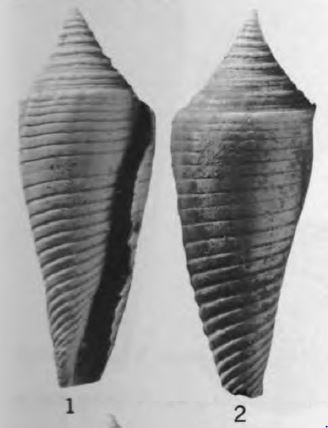
Conus aculeiformis Reeve
Plate 25, figures 1, 2
A small, slender, moderately high-spired shell covered with low flattened spiral ribs separated by finely cancellated grooves; whorls of concave spire showing four spiral ribs, the lowest one larger than the others.
Measurements of the figured fossil: length 19.5 mm, diameter 6.6 mm.
Occurrence.—Four specimens from SM242, Santo, New Hebrides; age, Pleistocene. The species lives today in the Philippines. MacNeil (1960, p. 121, pl. 6, fig. 29) compared a Miocene form from Okinawa with this species and discussed closely related species from the Pliocene of Indonesia. MacNeil's figured specimen appears to be identical with a Pliocene form from Fiji described below as a new subspecies of C. aculeiformis.
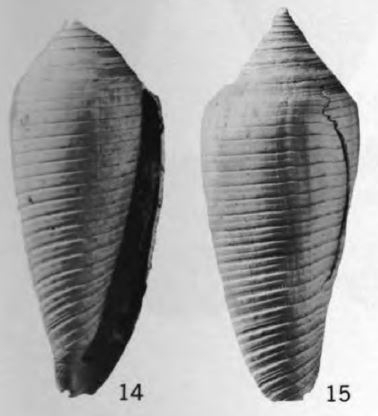
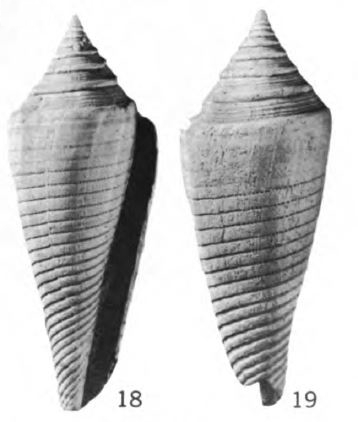
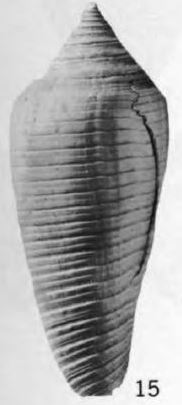
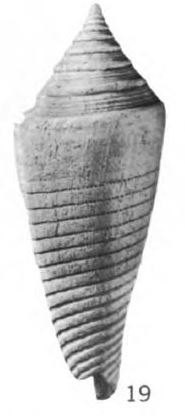
Conus aculeiformis mckinneyi Ladd, n. subsp.
Plate 24, figures 14–19
Conus cf. C. aculeiformis Reeve, MacNeil, 1960, U.S. Geol. Survey Prof. Paper 339, p. 121, pl. 6, fig. 29.
Shell medium to large in size with an elevated spire. Sculpture consisting of regularly spaced punctate spiral grooves separated by wide flat interspaces; each whorl of the flattened spire with four to six spiral ribs, of which the lowest is much larger than the others.
Measurements of the types: holotype, USNM 250136, length 39.7 mm, diameter 16.3 mm; paratype, USNM 250137, length 30.0 mm, diameter 11.8 mm.
The new subspecies is larger and stouter than Holocene and Pleistocene examples of C. aculeiformis Reeve, and on shells of the new subspecies, the lowest spiral on the whorls of the spire appears to be proportionately larger than on younger shells. C. aculeiformis mckinneyi appears to be identical with the Miocene shell from Okinawa figured by MacNeil.
The new subspecies is named for Robert H. Mc Kinney of the Geological Survey who made all the photographs of fossils in the present report except the SEM views.
Occurrence.—Numerous shells from station 817 (= 2B107 = R70) on Vanua Levu, Fiji; age, Pliocene (Tertiary h).
|
|
|
|
|
|
|
|
|
|
|
|
|
|
|
|
Bibliografia
(1) - Tertiary and Quaternary Gastropoda of Okinawa By F. STEARNS MACNEIL (1960)
(3) - Reeve, L. A., 1844. Monograph of the genus Conus. Conchologia Iconica, 1