|
|
|
|
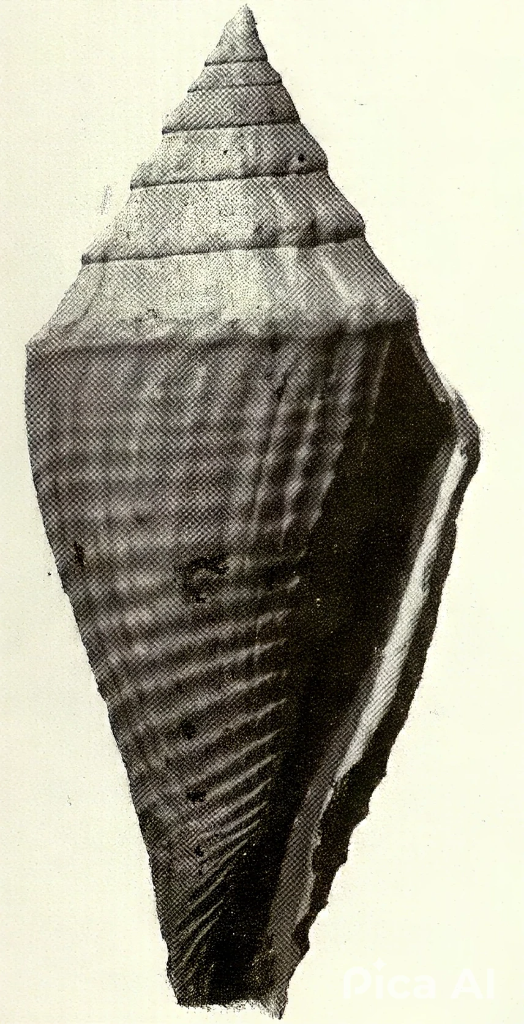
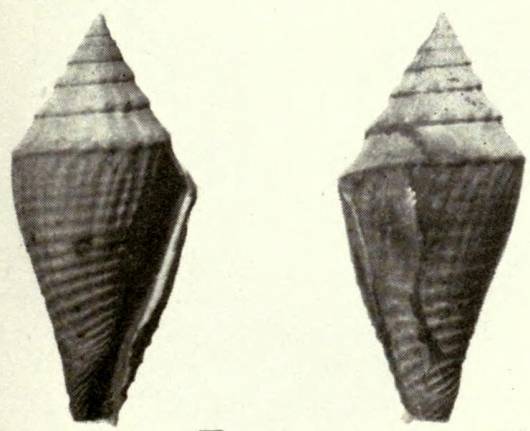
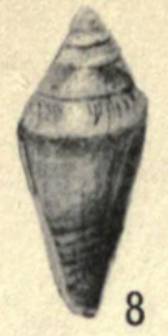
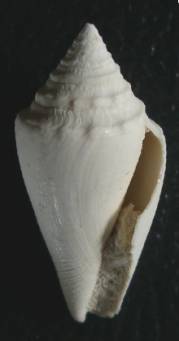
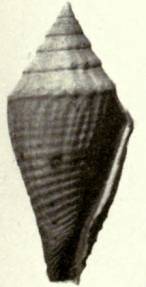
Conus amekiensis (Eames, 1957)
Description.
Of small-medium size, biconic. Protoconch rather tectiform, of three smooth, slightly convex whorls. Last whorl forming at least five-eighths of the height of the shell. Spire gently coeloconoid, of five to five and a half whorls with small nodes on an angulation close to the abapical suture; the narrow portion below the angulation vertical or sloping slightly inwards and causing a slightly imbricate appearance; upper part flattened or vaguely concave, shelving, with four or five spiral threads on its abapical two-thirds, the threads being slightly crenulated where crossed by the deeply concave growth-lines. Last whorl inverted-conic, shoulder with small, low nodes, base slightly excavated and neck slightly swollen; coarse, irregular spiral ribbons, which have narrow intervals and are fainter adapically, are vaguely beaded where crossed by low, flat ribs extending from the small nodes on the shoulder; the ribs are of about the same width as their intervals. Aperture narrow and parallel-sided, vaguely constricted near the abapical end, emarginate but not notched terminally.
REMARKS.
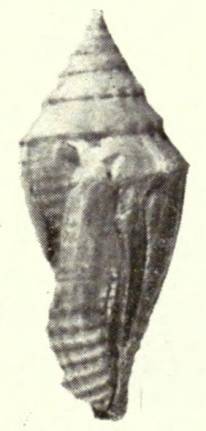
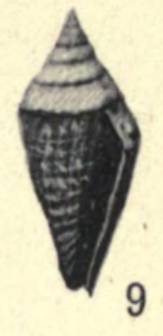
Conus parisiensis, with which Newton compared this species, is more produced abapically and has compound crenulations on the uppermost thread of the spire whorls (not small nodes on the lower angulation); its spiral ornament is not beaded and is restricted to the abapical half of the last whorl.
MATERIAL.
Several specimens, including the holotype (G.41837, Newton's fig. 9).
|
|
|
|
|
|
|
|
Bibliografia
Consultata
(1) - Eames (1957) “Eocene Mollusca from Nigeria. A Revision“
(2)
- GEOLOGICAL
SURVEY OF NIGERIA. BULLETIN No. 3. “Eocene Mollusca from
Nigeria.”