- Conus
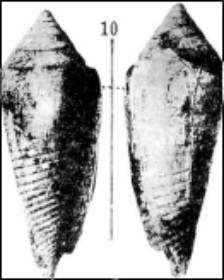
comatosaeformis (1)
-
Tonohama
|
- Conus
comatosaeformis YOKOYAMA,
1928 (XXXII. 29,
n. sp.). (1)
-
Lower Byoritz; South of Kwan in San, Taikei Gai, Shinchik.
-
Plate 87 fig. 10
-
-
Asprella
australis comatosaeformis (YOKOYAMA),
-
an ancestor of Asprella australis , the HOLTEN's species
Asprella australis (1803), fide KURODA verbally
|
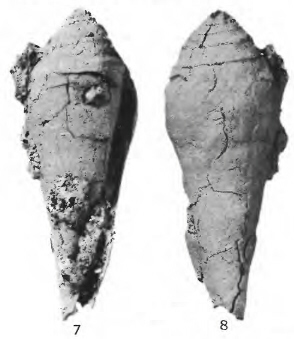
- Conus
comatosaeformis Yokoyama
(2)
-
Plate 10, figures 7-8
-
mm. 65 x 26
-
-
Conus
comatosaeformis Yokoyama,
1928, Imp. Geol. Survey
Japan Kept. 101, p. 29. pl. 1, fig. 10.
-
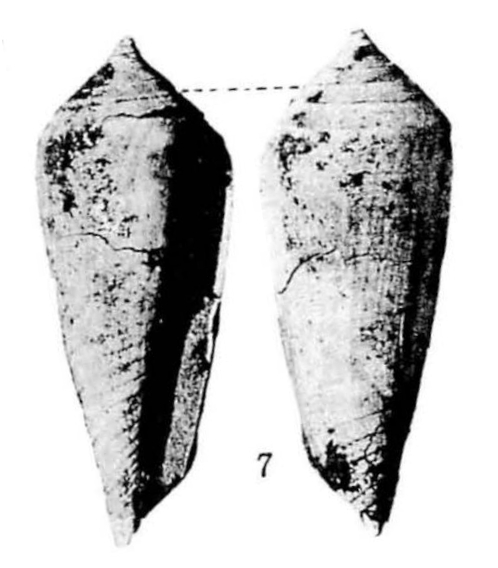
Yokoyama,
1929, Imp. Geol. Survey
Japan Kept. 104, p. 12, pl. 7, fig. 7.
-
Nomura,
1935, Tohoku Imp. Univ.
Sci. Repts.,
2d ser., v. 18, no. 2, p. 110.
-
Conus
(Asprella) comatosaeformis.
Hatai and Nisiyama, 1952, Tohoku Imp. Univ.
Sci. Repts., 2d ser., spec. v. 3, p. 192.
-
-
Nomura suggested that this species might prove to be a synonym
of C. aculeiformis but this is doutbful. The shell of
this species is very thin, which alone would distinguish them,
and moreover the shell is not as slender anteriorly as C.
aculeiformis. Unfortunately the spiral sculpture on the only
specimen found is nearly obliterated.
-
-
Conus
smirna Bartsch
and Rehder (1943, p. 87), a living Hawaiian species, compares
favorably with this species in shape and in the almost paper
thinness of the shell. Bartsch and Rehder stated that no similar
species was known to them. It was obtained from 257-312 fathoms.
-
-
Distribution: Miocene or Pliocene, (Shinzato tuff member)
Okinawa; Pliocene, (Byoritzu beds) Formosa, (Konomine formation)
Japan.
-
-
Localities: Shinzato tuff member, 17633 (figured).
-
-
Comparative
bathymetric data: The type of C.
smirma,
presumably a close relative of this species, was obtained off
Hawaii from between 257 and 312 fathoms.
|
|