|
|
|
|
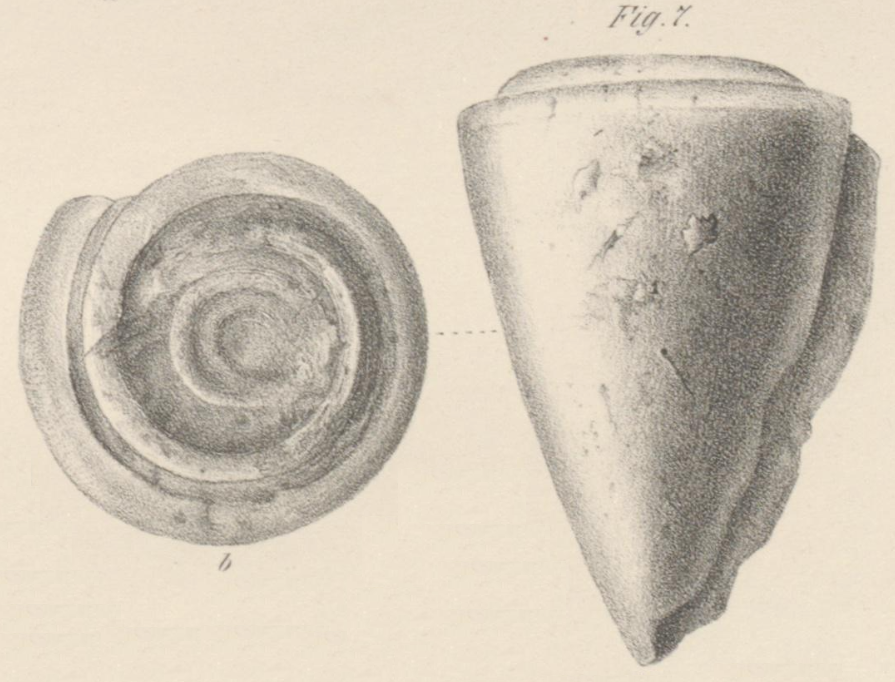
Conus pyramidalis (SCHAFHAUTL K.E., 1863)
Eine
durchschnittlich kleine, verkehrte, regelmässige, 11/2 mal so hohe
als breite Kegelform, von welcher nur der letzte und der Rand des
vorletzten Umganges sichtbar hervorragt. Die übrigen Umgänge liegen
alle in einer Ebene mit dem vorletzten. Ich besitze nur ein einziges
Exemplar, bei welchem sich die Umgänge von der Peripherie nach dem
Mittelpunkte etwas wenig erheben, und die ersten zwei oder
Anfangswindungen in einer kleinen Spitze über die übrigen
hervorragen.
Die Mundöffnung ist eine schmale Spalte, welche
sich an dem Spindelrande löffelartig erweitert, wie unten bei litt.
a. noch recht gut zu sehen ist, obwohl das Petrefact und also auch
die löffelartige Erweiterung im Profile gezeichnet wurde.
Durch
die constanten Dimensionsverhältnisse unterscheidet sich die Species
von den SOWERBY'schen Conus
brevis, C.
militaris,
C.
catenulatus.
Unter den Hunderten von Exemplaren, die durch meine Hände gingen,
fand ich ein einziges, welches in seinen Dimensionen etwas mit C.
catenulatus Sow.
übereinkam. Es fehlte ihm aber das spitze Anfangsgewinde.
Im
Emmanuelflötze.
Gehört zu den am häufigsten vorkommenden
Versteinerungen des Kressenberges, jedoch nur in der Höhe von etwa
20-27 Millimeter bei 15-20 Millimeter Basis.
Das gezeichnete ist
das grösste und in dieser Grösse einzige Exemplar aus Dr. HELL'S
Sammlung (1).
An
average small, inverted, regular conical shape, 1.5 times as high as
wide, of which only the last whorl and the edge of the penultimate
whorl visibly protrude. The remaining whorls all lie in the same
plane as the penultimate one. I possess only a single specimen in
which the whorls rise slightly from the periphery towards the center,
and the first two or initial whorls project above the others in a
small point.
The mouth opening is a narrow slit, which widens
spoon-like at the edge of the spindle, as can still be seen quite
well below in litt. a., although the petrefact and thus also the
spoon-like widening were drawn in profile
Due to its constant
dimensional ratios, this species differs from Sowerby's Conus
brevis, C.
militaris,
and
C.
catenulatus.
Among the hundreds of specimens that passed through my hands, I found
only one whose dimensions somewhat corresponded to C.
catenulatus Sow.
However, it lacked the pointed initial spiral.
In the
Emmanuelflötze.
It is among the most common fossils of the
Kressenberg, but only in height, reaching about 20–27 millimeters
with a base of 15–20 millimeters.
The one shown is the largest
and, in this size, the only specimen from Dr. Hell's collection
(1)
Una
forma conica regolare, piccola e rovesciata, alta 1,5 volte la sua
larghezza, di cui sporgono visibilmente solo l'ultimo giro e il bordo
del penultimo. I giri rimanenti giacciono tutti sullo stesso piano
del penultimo. Possiedo un solo esemplare in cui i giri si innalzano
leggermente dalla periferia verso il centro, e i primi due giri, o
iniziali, sporgono al di sopra degli altri formando una piccola
punta.
L'apertura della bocca è una stretta fessura che si
allarga a forma di cucchiaio sul bordo del fuso, come si può ancora
vedere abbastanza bene in basso nella figura a), sebbene il manufatto
e quindi anche l'allargamento a forma di cucchiaio siano stati
disegnati di profilo.
Questa specie si differenzia da Conus
brevis, C.
militaris
e
C.
catenulatus di
Sowerby per le sue proporzioni dimensionali costanti. Tra le
centinaia di esemplari che mi sono passati tra le mani, ne ho trovato
solo uno le cui dimensioni corrispondevano in qualche modo a quelle
di C.
catenulatus Sow.
Tuttavia, era privo della spirale iniziale
appuntita.
Nell'Emmanuelflötze.
È uno dei fossili più
comuni rinvenuti nel Kressenberg, ma raggiunge un'altezza di soli
20-27 millimetri con una base di 15-20 millimetri.
Il disegno è
l'esemplare più grande e unico di queste dimensioni presente nella
collezione del dottor Hell (1).
|
|
|
|
Bibliografia