|
|
Conus tortuosostriatus (Toula, 1911)
Descrizione e caratteristiche:
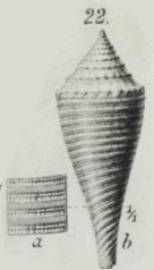
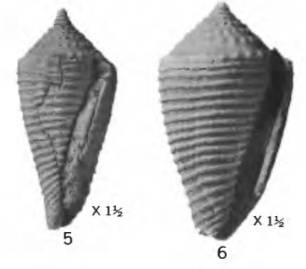
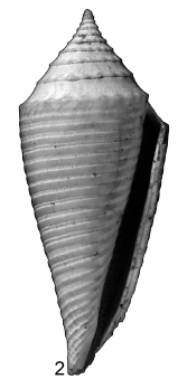
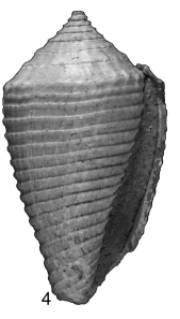
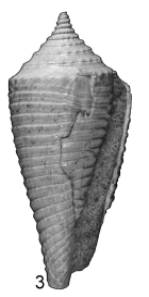
Leider liegt mir nur ein Exemplar dieser schönen Form vor. Die Gestalt der Schale ist schlank. Die Länge 30 mm, die größte Dicke 14 mm, 26,5 mm entfallen auf den letzten Umgang. Die obersten (ersten) Umgänge sind eine Spitze bildend vorgezogen ; vier Umgänge (nach den glatten Embryonalwindungen) sind eng und zierlich gekörnelt. Diese Körnelung läßt sich abgeschwächt auch auf den unteren Umgängen an der Windungskante erkennen. Die Oberflächen der drei letzten Gewindeumgänge sind in der Mitte leicht vertieft mit zarten Anwachs- und Spirallinien. Die Seitenfläche des letzten Umganges ist von der Kante abwärts mit kräftigen breiten und flachen Spiralen versehen (20 an der Zahl). Am etwas eingeschnürten untersten Schalenteile fünf einfache schwächere Spirallinien. Die obersten und unteren breiten Spirallinien zeigen noch je eine viel schwächere Zwischen-spiiale. Die Anwachslinien treten in den Spiralfurchen zwischen den Spirallinien besonders deutlich hervor (1).
Conus
burckhardti Böse
(1906, Boletin XXII, Taf. V,
Fig. 39-40) dürfte recht nahe stehen, zeigt aber die Skulptur des
Gewindes nicht und besitzt keine Zwischenspiralen. Leider hat Sowerby
(Q. J. 1850, pag. 44) keine Abbildung seines Conus
planiliratus von
San Domingo gegeben. Die ebenen Spirallinien könnten stimmen. Die
Abbildung, welche Guppy (Q. J. 186G, Taf. XVI, Fig. 7) unter diesem
Namen gegeben hat, stimmt nicht mit meiner Form überein. Derselbe
Autor hat eine besonders schlanke Form als Conus
gracilissimus bezeichnet,
die gewiß viele Ähnlichkeit besitzt, auch Körnelung der
Umgangskanten aufweist. Die Verhältnisse ergeben sich nach der
Abbildung mit: Länge 31,5 mm, Dicke (Weite) 10,5 mm, Länge des
letzten Umganges 27,8 mm (1).
Von
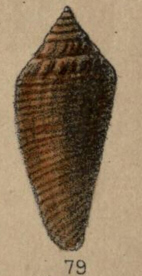
rezenten Arten hat C. strigatus Hwass,
unbekannten Vorkommens, in der Form der Schale, in der Windungshöhe
und der Form der Umgänge eine gewisse Ähnlichkeit (Tryon,
Conus,
Taf. XXIII, Fig. 79). Aber auch Dalls Conus
agassizii
(Blake- Ren. I. Taf. IX, Fig. 8) hat in der Form
des Gehäuses und des Gewindes eine gewisse Ähnlichkeit, freilich
ist die Spiralstreif ung eine ganz andere. — Dürfte mit der
vorangehenden Art in dieselbe Formen-gruppe gehören. Chelyconus
raristriatus Bell. (Sacco, 1. c. Taf.
IX, Fig. 13) aus dem Torton ist recht
ähnlich, aber entbehrt der zierlichen Spiralfurchung
(1).
Unfortunately, I only have one specimen of this beautiful form. The shape of the shell is slender. The length 30 mm, the largest Thickness 14 mm, 26,5 mm account for the last whorl. The top ones (first) whorls are advanced forming a point; four turns (according to the smooth embryonic whorls) are narrow and dainty grains. This granulation can also be weakened on the lower ones Recognize whorls at the whorl edge. The surfaces of three last whorls of the thread are slightly deepened in the middle with delicate growth and spiral lines. The side surface of the last ganges is from the edge down with strong broad and flat provide spirals (20 in number). At the somewhat constricted lowest shell parts five simple weaker spiral lines. The top and lower wide spiral lines each show a much weaker intermediate play. The growth lines appear in the spiral furrows between the Spiral lines stand out particularly clearly (1).
Conus
Burckhardti Böse
(1906, Boletin XXII, Plate V, Fig. 39-40) should be quite close, but
does not show the sculpture of the thread and has no intermediate
spirals. Unfortunately, Sowerby (Q.J. 1850, pag. 44) no illustration
of his Conus
planiliratus from
San Domingo given. The flat spiral lines could be correct. The
illustration, which guppy (Q. J. 186G, pl. XVI, fig. 7) under
this name given does not match my form. The same author has a
particularly slender shape as a Conus
gracilissimus,
which certainly has many similarities, also Graining of the handling
edges. The circumstances show according to the figure with: length
31,5 mm, thickness (width) 10,5 mm, Length of the last whorl 27,8 mm
(1).
Of extant
species, C.
strigatus Hwass,
unknown progenitor coming, in the shape of the shell, in the whorl
height and the shape of the whorls a certain resemblance (Tryon,
Conus,
Plate XXIII, Fig. 79).
But also Dall's Conus
agassizii (Blake-Ren.
I. Taf. IX, Fig. 8) has in the form of the housing and the thread a
certain resemblance, although the spiral striations are quite similar
other. — Should be in the same form with the preceding species
belong to group. Chelyconus
raristriatus Bell.
(Sacco, 1st c. Plate IX, Fig. 13) from the Torton is quite similar,
but lacks the ornamental common spiral groove (1).
|
|
|
|
|||
|
|
|||
|
|
|
|
|
|
|
|
|
|
Bibliografia
Consultata