|
|
|
|
|
|
Conus sewalli (Maury, 1917)
Description
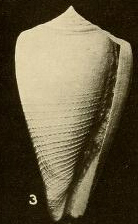
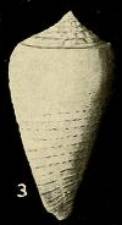
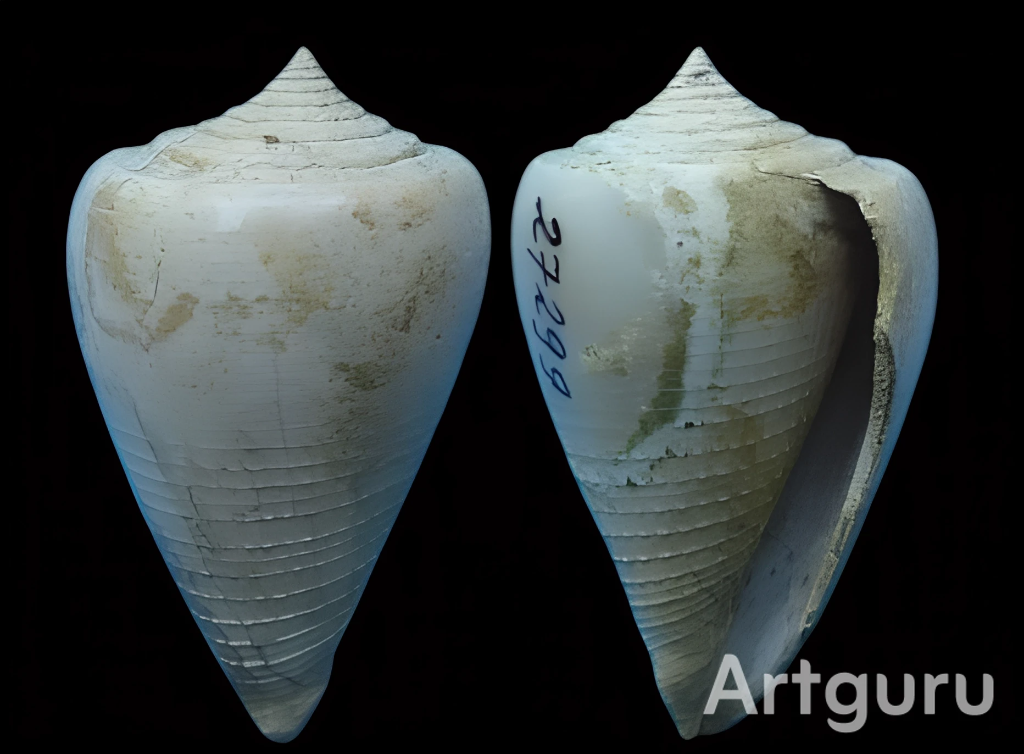
Shell rather large, sub-pyriform, spire short, acute; post-nuclear whorls about eleven, the first eight being spirally striate and delicately coronate, the last three are slightly channeled and strongly striated spirally; body whorl roundly angulate at the shoulder whence the sides slope convexly to the base, the ornamentation is limited to the lower two- thirds of the whorl and consists of beautiful, granular, spiral threads, the granules resembling the beads of a necklace; margin of outer lip nearly straight; posterior sinus rather deep; canal nearly straight (1).
Length of largest shell 59, greatest width 33 mm.
Dr. Dall most kindly examined this shell and noted that it had no representative in the collection of the National Museum. Apparently it is new. I take the greatest pleasure in naming this, our most exquisite Cone, in honor of Mr. Arthur Sewall of Philadelphia as a token of regard and gratitude for his encouragement and valuable help in assisting the progress of the Expedition (1).
Localities.
— (Exp'd '16) Bluff 1, Cercado de Mao; Zone E. Rio Gurabo at
Eos Quemados (1).
Length 38, width 16 mm.
This
species is named in honor of Mr. Axel Olsson, by whom it was
collected.
Locality. — (Exp'd '16) Zone D, Rio Gurabo at Los Quemados.
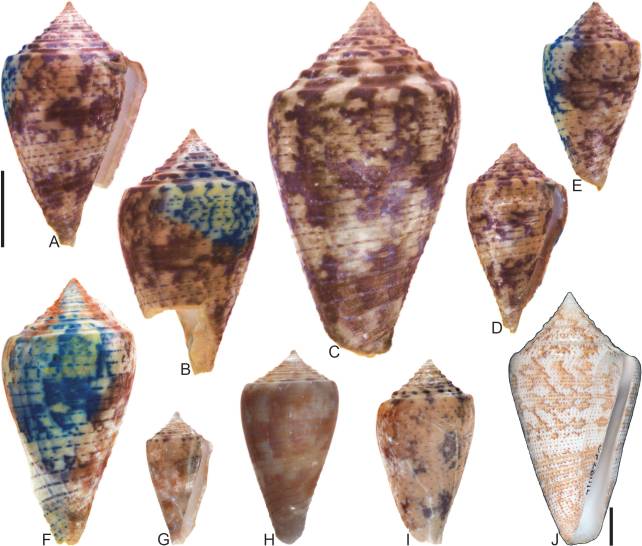
Coloration pattern (2)
Two weakly interacting patterns present. The primary (base) pattern consists of two elements:
1) both large and small irregularly shaped blotches concentrated into two regions on the last whorl—near the anterior end of the shell and below the PMD of the last whorl, leaving an unpigmented region just below the center;
2) small sub-triangular markings concentrated on the posterior third of the last whorl. The secondary pattern consists of 17–23 spiral rows of dots and dashes extending from the base to shoulder; spaces between dashes are sometimes unpigmented in instances where the secondary pattern overlies the primary pattern.
The secondary pattern coincides with spiral ornamentation features on the anterior end of the shell. The two patterns differ in the color of emitted light. The axial blotches associated with the primary pattern sometimes extend over the shoulder onto the sutural ramp (2).
Remarks (2)
Conus sewalli is similar in shell form to C. haytensis Sowerby I, 1850 (see below), another Dominican Neogene species, and the two taxa can be challenging to differentiate without observation of their coloration patterns. Most significantly, C. sewalli has sub-triangular markings on the last whorl, but these are absent in C. haytensis. Furthermore, the last whorl shape of C. sewalli tends to be more convex than that of C. haytensis, which is often slightly sigmoidal in profile (2).
The coloration pattern of C. sewalli is similar to C. bellacoensis sp. nov., as well as extant species such as C. mappa and C. curassaviensis that are members of the western Atlantic “Conus cedonulli Species Group” (2).
Tucker and Tenorio placed C. sewalli in the genus Purpuriconus da Motta, 1991, but the strong similarity between C. sewalli and extant species like C. mappa instead suggest that it belongs in the subgenus Stephanoconus (2).
|
|
|
|
|
|
|
|
Bibliografia Consultata