|
|
|
|
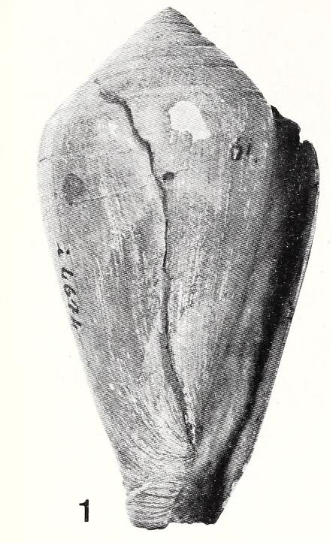
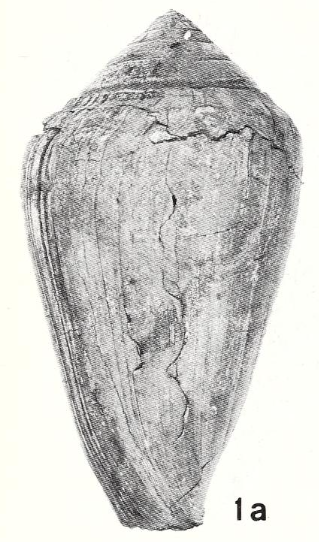
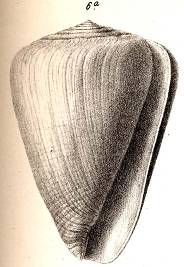
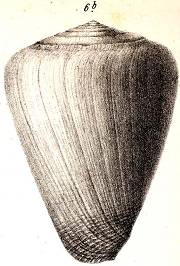
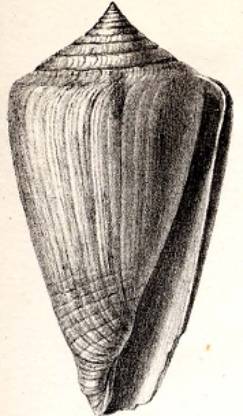
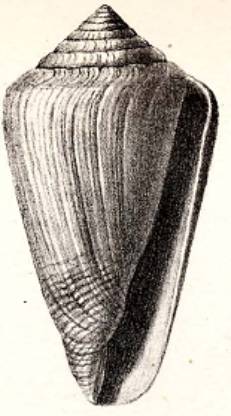
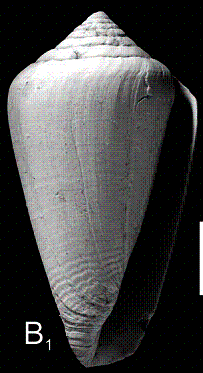
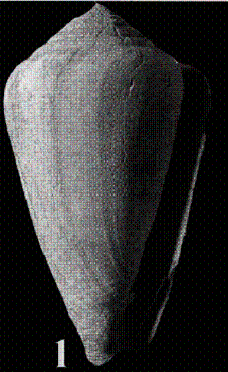
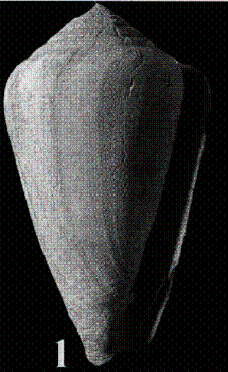
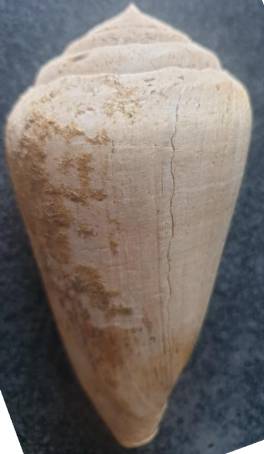
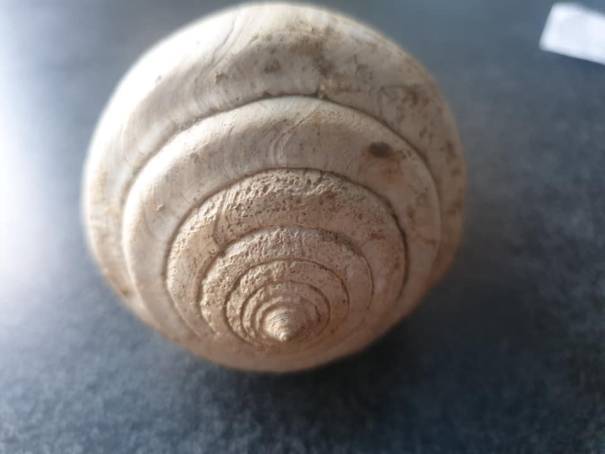
Conus (Chelyconus) ponderosus (Brocchi, 1814)
Conus (Chelyconus) ponderosus elmenus (Gregorio, 1885)
Conus (Rhizoconus) ponderosus grinzingensis (Sacco, 1893)
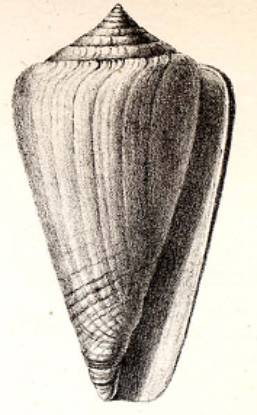
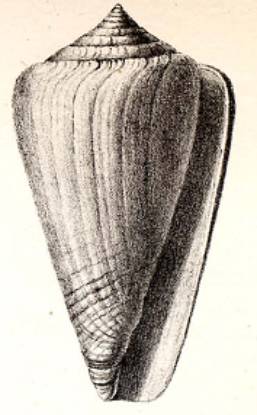
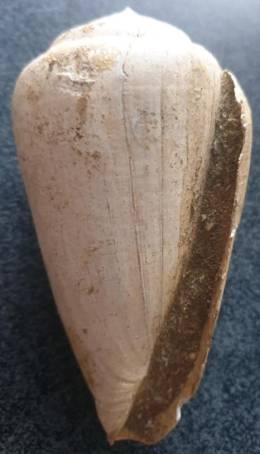
Conus pseudoponderosus (Dollfus & Dautzenberg in Glibert, 1952)
Conus kovacsi (Harzhauser & Landau, 2016)
Descrizione
e caratteristiche:
Le dimensioni e la forma di questa conchiglia sono molto variabili: sono stati rinvenuti esemplari da 19 a 92 mm. di lunghezza; gli esemplari del Pliocene sono di dimensioni maggiori rispetto a quelli appartenenti al Miocene(3). La conchiglia è robusta, la spalla è poco angolosa. L’apertura è abbastanza stretta ma si allarga verso la base. Il labbro è marginato superiormente. Alla base sono presenti striature trasversali. In alcuni esemplari il solco subsuturale è meno visibile ed in altre potrebbe essere quasi inesistente(1).
Dal punto di vista biometrico, alcune specie descritte da sacco (1893) quali Conus ponderovulatus e Conus globoponderosus, presenti anche nel senese, rientrano nel campo di variabilità di Conus ponderosus e potrebbero, quindi, rappresentare particolari morfo o ecotipi(5). Il Conus noe rappresenta una forma più affusolata del Conus ponderosus (5).
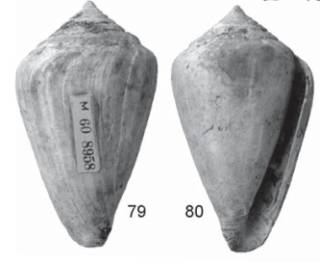
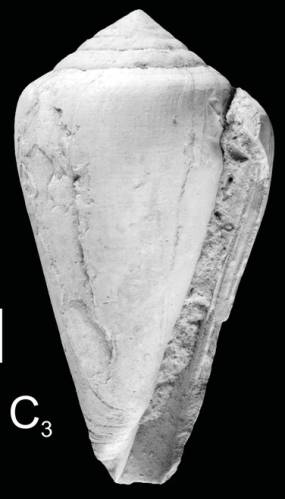
Revised description. Moderately large shells with low-medium conical to slightly cyrtoconoid spire; incised suture; spire whorls nearly flat or weakly convex, adapically concave; with faint spiral threads. Subsutural flexure shallow, moderately curved, moderately asymmetrical. Last spire whorl forming a nearly flat sutural ramp passing via a weakly angulated shoulder on the elongate conical last whorl; position of maximum diameter slightly below angulation. Base slightly constricted with weak spiral grooves; indistinct siphonal fasciole well demarcated from narrow inner lip. Siphonal canal moderately long, somewhat reflected. No colour pattern preserved.
Shell measurements and ratios. 3 specimens: SL: 88/71.0/70.0 mm, MD: 49/41.5/ 36.3 mm, spire angle: 107/ 93/100°, last whorl angle: 35/36/36°, LW: 1.80/1.71/1.93, RD: 0.65/0.74/0.62, PMD: 0.90/0.91/0.91, RSH: 0.15/ 0.21/0.16.
Discussion. This species is rather rare in the Paratethyan basins. Only few specimens from Steinebrunn ( Austria) agree with Miocene and Pliocene specimens as described by Hall (1966) and Davoli (1972). Several additional specimens from Poland and Hungary described by Krach (1981) and Kovács & Vicián (2013) might need confirmation. Herein we follow Hall (1966) in treating the Paratethyan shells described by Hörnes (1851) as conspecific with Conus ponderosus. Consequently, we consider Conus elmenus, which was introduced by De Gregorio (1885) as new name for the specimen illustrated by Hörnes (1851, pl. 2, fig. 6), as subjective junior synonym of Conus ponderosus Brocchi, 1814. Nevertheless, the species concept of Hall (1966) was too wide and we reject his decision to treat Conus olivaeformis Hoernes & Auinger, 1879 and C. transsylvanicus Hoernes & Auinger, 1879 as synonyms of C. ponderosus (see discussions of respective species).
Paleoenvironment. Shallow marine environments (e.g. Letkés, Kovács & Vicián 2013).
Distribution in Paratethys. Badenian (middle Miocene): Vienna Basin: Steinebrunn ( Austria) (Hörnes 1851); Pannonian Basin: Letkés ( Kovács & Vicián 2013); Carpathian Foredeep: Korytnica, Węglinek, Łychów ( Poland) ( Bałuk 1997).
Proto-Mediterranean Sea and north eastern Atlantic. Tortonian (late Miocene): Po Basin: Montegibbio ( Italy) ( Davoli 1972); Pliocene: Po Basin, Toscana ( Italy) ( Pinna & Spezia 1978; Chirli 1997).
|
|
|
|
|
|
|
|
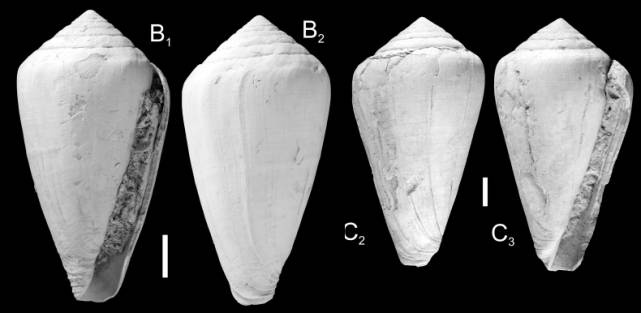
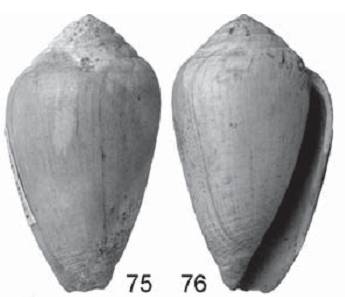
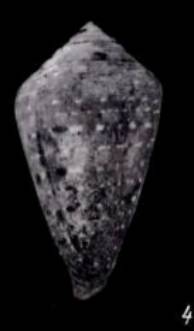
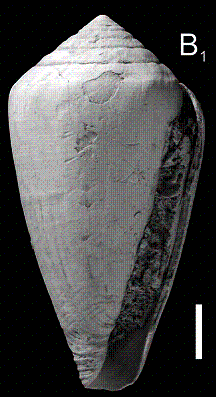
Revised description. Moderately large to large, solid shells with broad conical to weakly cyrtoconoid spire and broad conical last whorl. Spire whorls weakly convex with deep suture, not striate. Subsutural flexure asymmetrically curved, rather shallow. Last whorl with broadly rounded shoulder, rarely slightly angulate. Siphonal fasciole broad, weakly swollen; siphonal canal short, wide, straight. Colour pattern consisting of about 15 spirals of widely-spaced subquadratic and rectangular dots (see Bohn-Havas 1973, pl. 9, fig. 12).
Discussion. This species was described by Glibert (1952a) from the Langhian of the Loire Basin. Later Strausz (1966) and Bohn-Havas (1973) identified this species also in the coeval deposits of the Paratethys. The broad conical outline, rounded shoulder and slightly convex spire whorls allow a clear separation from Lautoconus ponderosus. Therefore, we consider it a distinct species as proposed also by Vaessen (2010). The internal cast illustrated by Strausz (1966, pl. 69, fig. 11, pl. 70, fig. 1) might also represent this species. In our opinion, the Paratethyan records of Lautoconus conoponderosus (Sacco, 1893) also represent L. pseudoponderosus (e.g. Kovács & Vicián 2013, fig. 113, which is a hardly distinguishable from the holotype of L. pseudoponderosus). Despite the similarity in shape, L. conoponderosus as defined by Davoli (1972) is smaller and more slender.
Paleoenvironment. Shallow marine environments (e.g. Letkés, Kovács & Vicián 2013).
Distribution in Paratethys. Badenian (middle Miocene): Pannonian Basin: Várpalota, Bánd, Diósd, Letkés, Szob, Budapest: Illés street, Kerepesi street ( Hungary).
Proto-Mediterranean Sea and northeastern Atlantic. Langhian: Loire Basin ( Glibert 1952a); Tortonian: Cacela Velha, Cacela Basin ( Portugal) ( Glibert 1952a).
Conus pseudoponderosus
|
|
|
|
|
|
Distribuzione e periodo geologico:
Francia: Elveziano.
Italia: da metà Miocene (Piemonte) al Pliocene, abbastanza comune nel Mediterraneo.
Austria: Vindoboniano.
Polonia: Miocene.
|
|
||
|
|
|
|
|
|||
|
|
||
|
|
|
||
|
|
|
|
|
|
|
|
Bibliografia
Consultata
(2) - Carlo Chirli (1997) “Malacofauna pliocenica toscana - vol. I - Superfamiglia Conoidea”, Firenze
(9) - Harzhauser, Mathias & Landau, Bernard, 2016, A revision of the Neogene Conidae and Conorbidae (Gastropoda) of the Paratethys Sea, Zootaxa 4210 (1), pp. 1-178: 88 Lautoconus pseudoponderosus
(11) - Harzhauser, Mathias & Landau, Bernard, 2016, A revision of the Neogene Conidae and Conorbidae (Gastropoda) of the Paratethys Sea, Zootaxa 4210 (1), pp. 1-178: 106-108 Lautoconus ponderosus
(12) - Dulai (2005) “A Börzsöny-hegység üledékes kőzetei és ősmaradványai”
(13) - Bohn Peter, Havas Margit, Leonard Tamas (1966) “FLUORESZCENCIÁS VIZSGÁLATOK A FÖLDTANBAN”